Precision engineering
Profile Grinding vs Wire EDM: Which One Actually Holds Your Punch Tolerance?
Profile grinding vs wire EDM for stamping punches and die inserts: tolerance, edge quality and the recast layer compared, with when to use each.
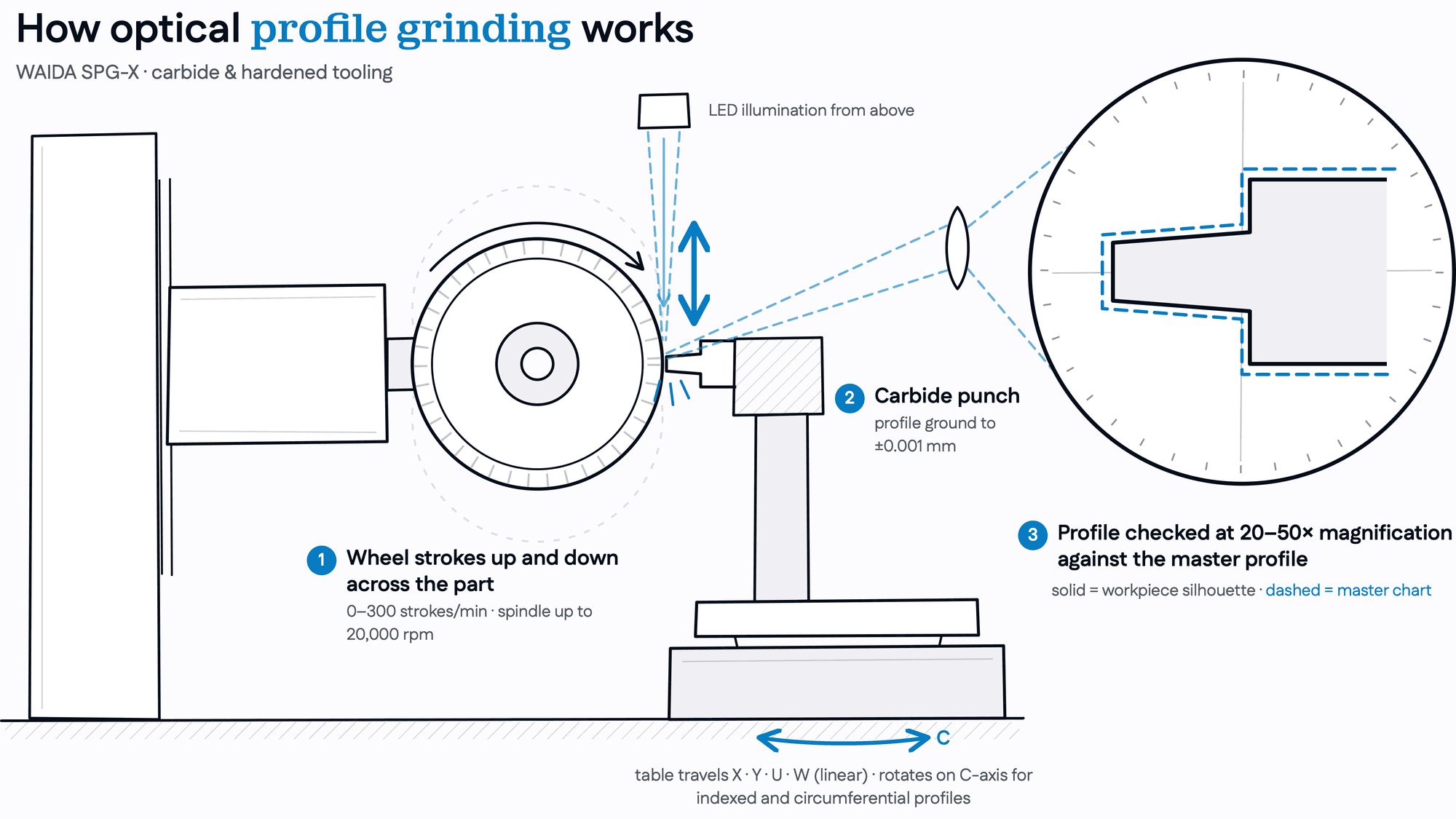
If you are deciding between profile grinding and wire EDM for a stamping punch or die insert, the honest answer is that most precision tooling needs both, in the right order. Wire EDM roughs the profile fast in hardened material; profile grinding finishes it to the tolerance and edge quality that decides how long the tool survives in production. This post explains where each process wins, where each falls short, and how to spec a part so you are not paying for accuracy you do not need or losing tool life you cannot afford.
K-TOOL Engineering has run both processes side by side in Bayan Lepas, Penang for three decades, on connector tooling, semiconductor test components and progressive stamping dies. The comparisons below come off the shop floor, not a spec sheet.
Profile grinding vs wire EDM at a glance
Both processes cut precise profiles into hardened material, which is why they get compared. They behave very differently at the cutting edge, and that difference is the whole decision.
Wire EDM erodes material with a series of electrical discharges between a thin travelling wire and the workpiece. It cuts any conductive material regardless of hardness, handles tall parts and fully internal profiles, and needs no mechanical contact force. What it leaves behind is a recast layer: a thin skin of melted and re-solidified material, often with micro-cracks, along the cut surface. Skim passes reduce that layer but do not eliminate it.
Profile grinding removes material mechanically with a shaped or dressed grinding wheel, working against a magnified optical projection of the part profile. It leaves no recast layer, holds tighter profile tolerances, and produces a clean, sharp, metallurgically sound edge. It works only on the outside of accessible profiles, needs the part already hardened, and is slower at bulk material removal than EDM.
In short: wire EDM is the fast, flexible rougher that reaches anywhere. Profile grinding is the finisher that delivers the edge.
What is profile grinding?
Profile grinding, sometimes called optical profile grinding or form grinding, uses a shaped grinding wheel to produce a precise 2D profile along the length of a hardened workpiece. On an optical profile grinder, the operator works against a magnified projection of the part overlaid on the master drawing geometry, checking the ground form against the master profile in real time at 20x to 50x magnification.
Unlike surface grinding, where the table traverses horizontally under the wheel, the profile grinder's wheel head strokes vertically, up and down across the part, following the projected profile. The wheel does the forming; the table positions the work.
The result is a finished profile with tolerances down to ±0.001mm and fine surface finishes, typically Ra 0.2µm or better on carbide and tool steel. That combination of form accuracy, edge sharpness and surface integrity is why profile grinding is the standard final operation on stamping punches and precision die inserts. Because grinding happens after heat treatment, the finished profile is not affected by the distortion that hardening introduces into pre-machined soft parts.
When should you use wire EDM?
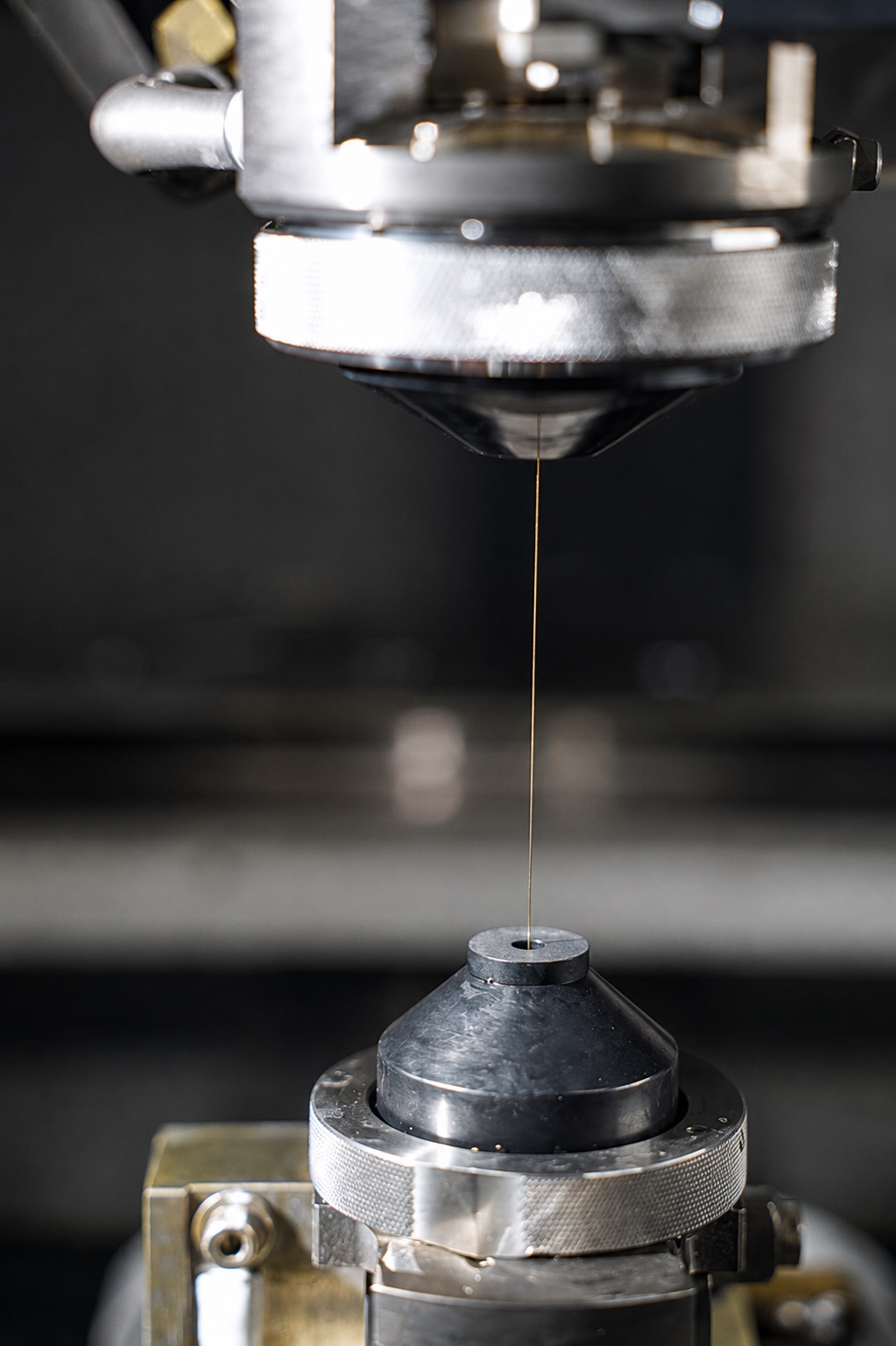
Wire EDM is the right first choice when the geometry or the material rules grinding out, or when grinding would simply be slower for no benefit.
Use wire EDM when:
- The profile is fully internal, such as a die opening or a closed aperture a wheel cannot reach
- The part is tall and the profile must stay consistent through significant thickness
- You need to remove a lot of material from a hardened blank quickly, before finishing
- The tolerance the drawing calls for, roughly ±0.002mm to ±0.003mm on well-controlled machines, is comfortably within EDM capability and the edge is not a high-cycle cutting edge
Perfect for:
- Die openings and internal apertures in progressive dies
- Roughing punch and insert blanks before profile grinding
- Conductive parts too hard or too intricate to mill
The catch is the recast layer. On a punch that strikes a die millions of times, the recast zone is where edge chipping starts. For a cutting edge that has to last, wire EDM alone is usually not the finish you want.
When should you use profile grinding?
Profile grinding is the right choice when the finished edge and the tightest tolerances matter, which on stamping tooling is most of the time. Read more about our profile grinding service.
Use profile grinding when:
- The part is a cutting punch or die insert whose edge life determines tool life
- The profile tolerance is tighter than EDM holds reliably, down to ±0.001mm
- You need a clean, recast-free edge and a fine ground finish, Ra 0.2µm or better
- The form is an accessible external profile in hardened tool steel or carbide
Perfect for:
- Connector terminal punches with complex multi-radius profiles
- Carbide die inserts for high-volume progressive dies
- Test socket and burn-in tooling for semiconductor packaging
Profile grinding also reaches geometry that a straight up-and-down stroke alone cannot. Our Waida grinders run a C-axis that rotates the table, so we can grind indexed and circumferential profiles, not just a single 2D plane. That covers work like multi-flute form tools and round parts with features spaced around the circumference.
Why the two processes work together
The most common real-world answer is not one or the other. A typical carbide stamping punch is roughed by wire EDM with grinding stock left on the profile, then finish ground to final size and edge condition. You get the speed and reach of EDM for material removal and the accuracy and edge integrity of grinding where it counts.
This is why running both under one roof matters. When the same shop plans the wire EDM roughing and the profile grinding finishing together, grind stock and datum strategy are decided as one job rather than negotiated between two vendors, each protecting their own tolerance. The tolerance stack-up stays controlled, and a broken punch can be requalified and reground without shipping the part across town.
We cover the wider process chain, from milling the blank through heat treatment coordination to final inspection, in our precision engineering in Malaysia overview.
Tolerances, finishes and materials
Numbers matter more than adjectives here, so these are the figures we quote against.
Profile tolerance: ±0.001mm is achievable on ground profiles in carbide and tool steel. Wire EDM holds roughly ±0.002mm to ±0.003mm on well-controlled machines. Not every feature needs the tighter number, and grinding or cutting to the looser tolerance where the drawing allows keeps cost down.
Surface finish: ground profiles reach Ra 0.2µm or better. Wire EDM finish depends on skim passes and is coarser, with the recast layer as the real concern rather than the Ra figure alone.
Materials: both processes handle tungsten carbide (including submicron grades), D2, SKD11, H13, ASP23 and other PM steels, and hardened stainless. Carbide grinding uses diamond wheels and is a distinct discipline from steel grinding; a shop should be able to tell you which wheel specifications it runs for each.
Edge condition: ground edges are recast-free and burr-controlled. For a stamping cutting edge, that is the difference between a punch that survives its projected hit count and one that chips early.
Whichever process finishes the part, the tolerance is only as real as the measurement behind it. Our parts are inspected on calibrated equipment under our ISO 9001:2015 system, with reports supplied against your drawing. More on that on our quality assurance page.
Frequently asked questions
Is profile grinding better than wire EDM for stamping punches?
For the finished cutting edge, yes. Wire EDM leaves a recast layer that becomes the initiation point for edge chipping in stamping production, while a ground edge is metallurgically clean. The usual approach is wire EDM for roughing and profile grinding for the finished profile, combining the strengths of both.
What tolerance can profile grinding achieve compared to wire EDM?
Profile grinding holds down to ±0.001mm on ground profiles in carbide and tool steel. Well-controlled wire EDM typically holds around ±0.002mm to ±0.003mm. The right target depends on the feature; specifying tighter than the function needs only adds cost.
Can wire EDM cut internal profiles that grinding cannot?
Yes. This is one of wire EDM's clear advantages. A travelling wire can cut fully internal openings and closed apertures that a grinding wheel cannot physically reach, which is why die openings are usually wire cut and mating punches are often ground.
Does the recast layer from wire EDM really matter?
For a high-cycle cutting edge, it does. The recast layer is a thin re-solidified skin, often micro-cracked, that becomes a starting point for chipping under repeated impact. Skim passes reduce it; finish grinding removes it. For non-cutting features it is often acceptable as-cut.
Can both processes be done on the same part?
That is the normal case for precision tooling. The part is roughed by wire EDM with grinding stock left on the profile, then finish ground. Running both in one shop keeps the tolerance stack-up and datum strategy controlled across the whole job.
Get a quote for punch and die insert grinding
If you have a punch, die insert or ground component drawing on your desk, send it over. We will come back with a committed price and lead time, recommend the right combination of wire EDM and profile grinding for the part, and flag anything on the drawing worth discussing before metal is cut.
Request a quote